What Is HRV — and Why Every Health Tracker Obsesses Over It (A Plain-English Guide)
Last updated: April 2026 | Category: Health
If you own an Oura Ring, WHOOP, Apple Watch, or Garmin, you’ve seen the number: HRV.
Some mornings it’s high and your device says you’re ready to crush the day. Other mornings it’s low and it suggests you rest. But what is HRV actually measuring — and does it matter enough to change your behavior based on it?
Here’s the honest answer, without the biohacker hype.
What HRV Actually Is
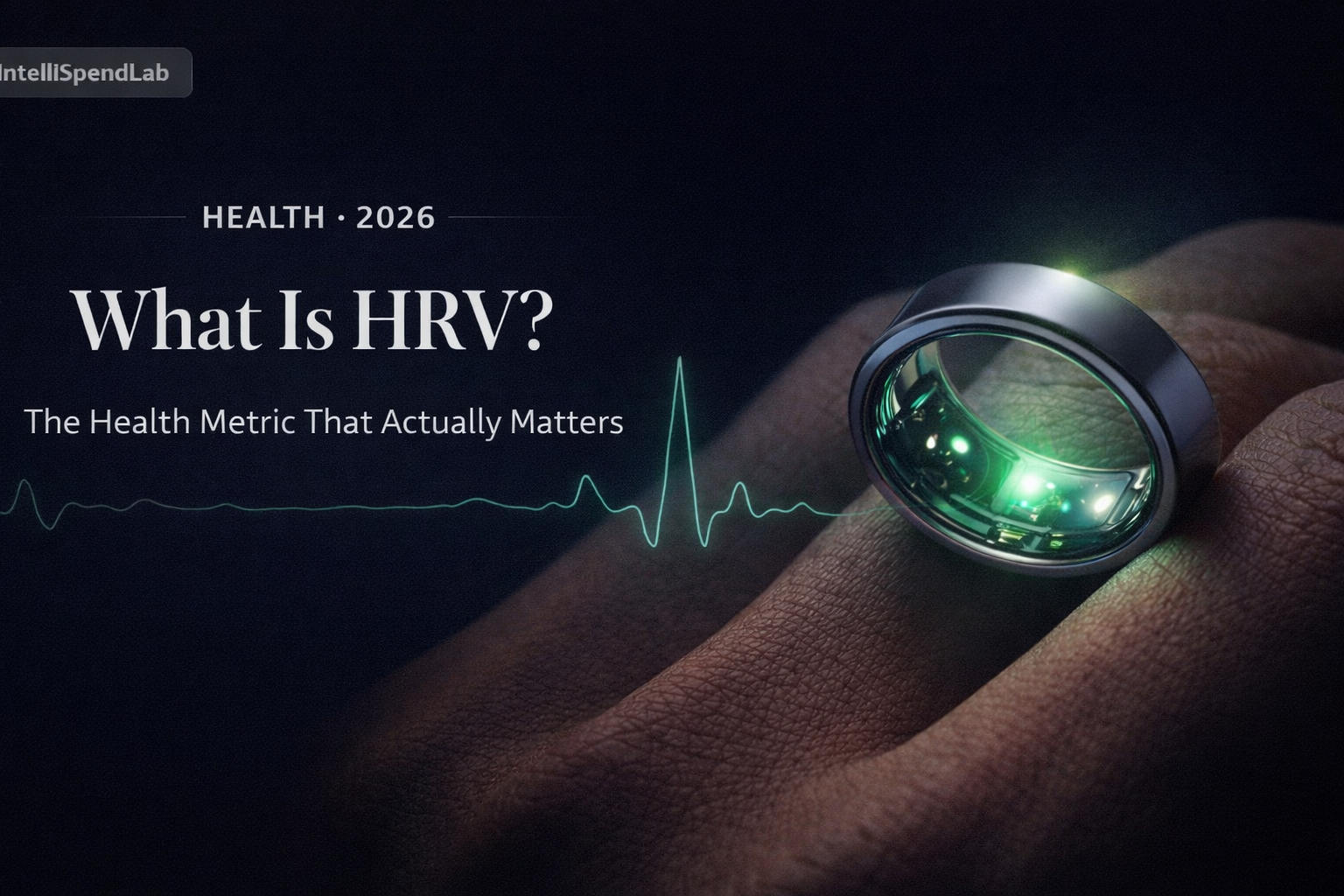
HRV stands for Heart Rate Variability. It sounds like it measures how fast your heart beats — but it actually measures something more subtle and more interesting.
Your heart doesn’t beat like a metronome. Between consecutive beats, the gap varies slightly — sometimes 820ms, sometimes 860ms, sometimes 790ms. That variation is HRV.
High HRV = larger variation between beats = your autonomic nervous system is flexible, adaptable, and recovered. Low HRV = smaller variation = your body is under stress, fatigued, fighting something off, or in “survival mode.”
The reason this matters: HRV is one of the most sensitive windows into the state of your autonomic nervous system — the system that controls everything you don’t consciously manage: heart rate, digestion, immune response, stress hormones, and recovery.
Both WHOOP and Oura have been independently validated for HRV accuracy. A study comparing multiple consumer wearables to medical-grade ECG found that both achieved intraclass correlations near 0.99 for resting heart rate — essentially medical-grade accuracy. The differences between devices are smaller than most people expect. Heal Nourish Grow
Why Your HRV Score Changes Day to Day
HRV is highly sensitive to lifestyle factors. Understanding what drives it up or down is where the data becomes actionable.
Things that lower HRV:
- Alcohol (even 1–2 drinks — one of the most consistent HRV suppressors)
- Poor or short sleep
- High training load / overtraining
- Acute illness (HRV often drops 24–48 hours before you feel sick)
- Chronic stress
- Dehydration
- Jet lag and disrupted circadian rhythm
- Late meals before bed
Things that raise HRV:
- Consistent, adequate sleep (7–9 hours)
- Cardiovascular fitness (higher fitness = higher baseline HRV)
- Stress management practices (breathwork, meditation, cold exposure)
- Recovery weeks after hard training blocks
- Maintaining consistent sleep and wake times
- Adequate hydration
One user tagged stressors like ‘coffee,’ ‘argument,’ and ‘meetings’ in the app and suddenly knew exactly what made them most stressed — becoming a calmer person who takes breaks instead of pushing through. This is the behavioral change that wearable data can actually generate: not theoretical wellness, but real behavior modification based on data about your body. WearableXP
What’s a “Good” HRV Number?
This is where most people get confused. HRV scores are highly individual and not directly comparable between people.
A 28-year-old elite endurance athlete might have a baseline HRV of 90–110ms. A sedentary 45-year-old might be at 35–50ms. Both are normal for their baseline. What matters is your own trend over time — not comparing yourself to someone else.
General ranges by age (RMSSD measurement, which is what most wearables use):
| Age | Low | Average | High |
|---|---|---|---|
| 20–29 | <47ms | 47–83ms | >83ms |
| 30–39 | <38ms | 38–68ms | >68ms |
| 40–49 | <30ms | 30–55ms | >55ms |
| 50–59 | <23ms | 23–45ms | >45ms |
| 60+ | <18ms | 18–38ms | >38ms |
The more important number: your own 7-day or 30-day average. Most wearables use this baseline to generate your daily readiness score — comparing today against your recent normal, not a population average.
How to Actually Improve Your HRV (What the Research Supports)
1. Fix Sleep First — It’s Not Optional
Sleep is the single biggest lever for HRV. Consistently sleeping 7–9 hours — not just total time but quality and timing — drives HRV improvements faster than almost any other intervention.
Specifically:
- Go to bed and wake up at consistent times (circadian consistency matters)
- Avoid alcohol within 3–4 hours of sleep
- Keep your bedroom cool (65–68°F / 18–20°C is the research-backed range)
- Eliminate blue light 1 hour before bed
Most people who complain their HRV “never improves” are sleeping inconsistently or drinking regularly. Fix those two things first before trying anything else.
2. Build Your Aerobic Base
People are connecting what’s happening inside their bodies — stress, sleep, inflammation — to how their skin and hair actually show up, and they’re using data and tech to guide those choices. The same principle applies to HRV: it’s a downstream signal of overall systemic health, not an isolated metric. Beauty Independent
Zone 2 cardio — easy aerobic work where you can hold a conversation — is the most reliable long-term HRV builder. 3–4 sessions per week of 30–45 minutes at low intensity (roughly 60–70% max heart rate) improves parasympathetic nervous system function over weeks and months.
The mistake most people make: training too hard too often, which suppresses HRV from accumulated stress rather than building it.
3. Breathwork — The Fastest Acute Intervention
Slow, controlled breathing at 5–6 breaths per minute (roughly 4 seconds in, 6 seconds out) activates the parasympathetic nervous system within minutes and produces measurable acute HRV increases.
This is why breathing exercises show up in every HRV optimization protocol. It’s not pseudoscience — it’s direct parasympathetic activation via the vagus nerve.
Practice: 5 minutes of box breathing (4 in, 4 hold, 4 out, 4 hold) before bed. Takes 2 weeks of consistency to show meaningful baseline improvement in morning HRV scores.
4. Manage Alcohol Strategically
If you drink regularly and want to improve HRV, this is probably your highest-leverage change.
The Oura Ring made one user go to bed earlier and improved their sleep quality — the data “hated that it worked.” One feature flagged something seemed wrong one day, and 24 hours later the user was sick with a stomach bug. The illness prediction comes from temperature and HRV deviations that appear before you consciously feel symptoms. Overkill Media
Alcohol suppresses HRV significantly, often dropping scores by 15–25% the night after drinking. Even 2 drinks 3 hours before bed produces measurable HRV suppression visible in your morning score. The data on this is some of the most consistent in wearable research.
5. Cold Exposure (If It Works for You)
Cold showers and cold plunges produce acute parasympathetic rebounds after the initial stress response — resulting in temporary HRV spikes. Whether this translates to long-term baseline improvement is less certain, but the acute effects are well-documented.
Start small: 30–60 seconds cold at the end of a warm shower. The HRV response comes in the recovery period, not during the cold itself.
Should You Change Your Training Based on HRV?
This is the practical question for anyone who exercises.
The research-backed approach: use your HRV trend (not a single data point) to modulate training intensity. A 7-day rolling average that’s significantly below your normal baseline is a signal to reduce intensity or take an extra rest day.
A single low HRV morning after a bad night’s sleep doesn’t mean cancel your workout. A week of consistently suppressed HRV despite normal sleep suggests accumulated fatigue that warrants backing off.
Oura is the better choice if you prioritize sleep tracking accuracy and want a discreet form factor. WHOOP is stronger for athletes who want strain-based training guidance. Both are excellent recovery trackers — the decision comes down to form factor preference and how you feel about subscriptions. Simplewearablereport
Either device gives you the HRV data you need. The question is whether you’ll actually act on it.
The Bottom Line
HRV is a genuinely useful health metric — one of the few wearable data points with solid research behind it. But it’s a signal, not a prescription.
The highest-value actions are also the least glamorous: sleep consistently, drink less, build aerobic fitness, manage stress. Every device will tell you this. The question is whether seeing the number every morning makes you more likely to actually do it.
For most people, the answer is yes. That’s what makes HRV tracking worth the investment.
Related reads: